Apartments for rent in central Riga, Latest rentals, Map search
Centrs
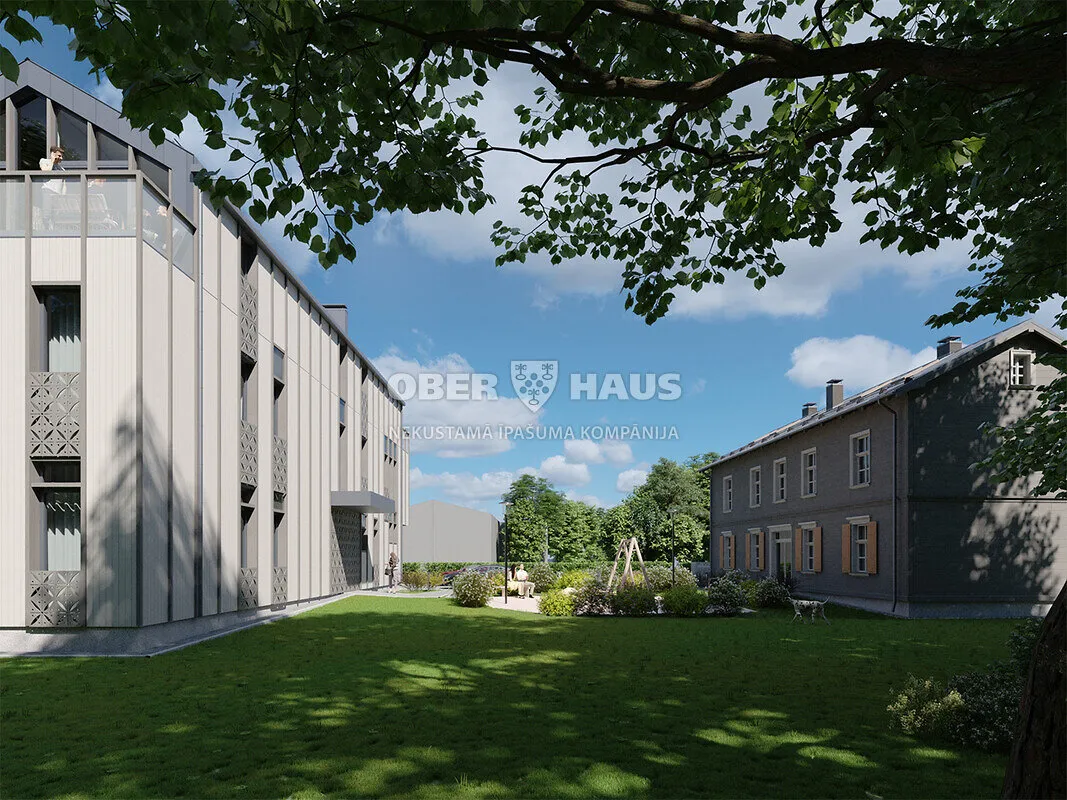
We offer a great 3-room apartment in a low-rise residential building reconstruction project in Ķīpsala: Zvejnieku Street 18.The apartment has a very high ceiling height, which will allow the owner to create a small additional office on the second floor with an area of 10m2.A four-apartment building with a courtyard, parking lots and in the future another beautiful building. Excellent execution, in which the wooden building and the new modern new building create a harmonious and tasteful execution of the project.The team of architects: Uģis Zābers; Marta Rutka and Brigita Bīviņa began designing two buildings on Zvejnieku Street 18 in 2019.When thinking about the transformation of the old wooden building, the project developer and architects, together with the RB@B eco-builder team, chose early on to ensure a good indoor climate and high quality of living by choosing the construction material. And what is more natural and health-friendly than wood? RB&B wood fiber boards are produced using the wet method without artificial bonding.When insulating buildings and facing a variety of situations, RB@B has created a unique insulation system. By combining thermal insulation materials tested in their own experience in a certain sequence and thickness, and by properly incorporating them into structures, it is possible to insulate a building that is as energy efficient as the owner is willing to pay for heating. It can also be a zero-energy house.In construction, wood fiber boards are used in combination with clay. Wood fiber boards that can be embedded in floors, ceilings, and walls. Wood fiber boards ensure that living spaces do not heat up so quickly and regulate humidity, creating a very good microclimate. Wood fiber boards also provide very high thermal insulation. Clay is also an excellent finishing material; using it in combination with wood-fiber boards, you can build a very warm house that does not heat up and does not have excess moisture in the air. Harijs Tučs emphasizes - in Latvia, people still think very little about how the indoor microclimate affects their health, and then pay doctors out of their own pockets. In developed European countries, where medicine is paid for by the state, the indoor microclimate is regulated at the national level - by the construction law prohibiting people from living in buildings where there is a microclimate that is harmful to health. The project uses hemp material thermal insulation. Hemp thermal insulation material is completely natural and ecological, no chemicals are added to it during the production process. Hemp thermal insulation has a low thermal conductivity of λ W/(m∙K) 0.04, so the material does not allow cold to penetrate indoors in winter, while in summer it prevents the rooms from heating up. Hemp contains natural antiseptic substances, when incorporated into thermal insulation material structures, it will not rot, and the material is also non-combustible. Hemp has a specific smell, so rodents, such as mice, will not gnaw it.Natural linseed oil paints for wood are used for painting the building, which are used for interior and exterior work, they are made from linseed oil, wood tar and turpentine. Linseed oil for wood is a sustainable and environmentally friendly solution for finishing and protecting wooden surfaces.The low-rise wooden building has four apartments with areas: on the first floor, apartment 1 with an area of: 48.7 m2 and apartment 2: 48.7 m2. On the second floor, apartment 3 with an attic of 48.7 m2 and apartment 4 with an area of: 48.7 m2.The entrance doors, recognized as valuable by the AMI, are preserved and restored. Where possible, other decorative elements are preserved and restored.Wooden double-glazed windows with historical decorative elements.Ceiling height for first-floor apartments:Ceiling height for second-floor apartments.ĶīpsalaOver the course of history, low-rise residential buildings have developed in Ķīpsala, which is currently a monument of urban development of national importance, and the territory of Ķīpsala is included in the UNESCO World Cultural and Natural Heritage Sites.A significant development in the preservation of the wooden architectural heritage of Ķīpsala was made by architect Zaiga Gaile, on whose initiative four historical buildings were restored – the ,,Ķīpsala Collection’’. It consists of a mid-19th century classicist-style building at Balasta dambī no. 60a, a 19th century house at Balasta dambī 60, a baroque-style residential house at Ogļu Street 6; house on Zvejnieku Street 5a, and the Celma & Bēma plaster factory in 2003, when, at the initiative of Zaiga and Māris Gaiļi, it was transformed into a modern residential complex, becoming the first example in Latvia where a former industrial factory becomes an apartment building of exclusive planning and design.The modern glass and concrete building on Ogļu Street, which resembles an egg from a bird's eye view, is the new home of culture, art and education - OLA FOUNDATION. The building is an experiment by experienced architect Uldis Pīlēns with the latest technologies, ideas and achievements in architecture.In the future, it is planned to create a floating recreation area in the Zunda Canal, improving the water area and the coast, emphasizing the unique identity of the Ķīpsala neighborhood, which is already historically associated with water traffic, as well as creating new green and recreational areas for city dwellers.The International Exhibition Center in Ķīpsala is the largest specialized exhibition center in the Baltic States. The International Exhibition Center hosts exhibitions, conferences, congresses, fairs, musicals, and more.Read more